Clinical Study Report · first module
Turn statistical output into a Clinical Study Report you can file
ClinAI Studio reads your protocol, statistical analysis plan and TLF output, drafts each section against the ICH E3 structure, and keeps a source behind every sentence it writes. Every decision stays with the medical writer; the AI only ever supplies the draft.
What this system stands on
- ICH E3 structure
- The report outline follows the ICH E3 section structure, and each section routes to a writing skill authored for it.
- Sentence-level provenance
- Every inserted table and figure carries a reference to its source document and location, pinned by content hash.
- Complete audit trail
- Who changed what and when — and which prompt version and inputs the AI used — is replayable.
- Data stays in the jurisdiction you choose
- Deployed in Hong Kong by default, encrypted at rest with independently held keys. Private deployment available on request.
The status quo
The bottleneck in a CSR was never the typing
A Clinical Study Report folds the protocol, the statistical analysis plan, several hundred tables and a whole team's judgement into one document that has to agree with itself. Most of the time goes into checking: which table did this number come from? Does this paragraph survive the protocol amendment? Do two sections describe the same endpoint the same way?
- Tables and narrative live in two different tools, so reconciliation runs on eyes and memory.
- After a protocol amendment, nobody can say precisely which paragraphs need rewriting.
- A general-purpose model writes fluent paragraphs but cannot tell you what they rest on.
Who it is for
No two CSR teams are in the same position
Same tooling, different pressures.
Sponsor medical writing teams
Several programmes running at once, with templates and terminology that have to stay consistent across a portfolio. The study profile and writing skills hold that consistency, so it no longer depends on one senior writer's memory.
CRO delivery teams
Tight delivery windows, and a different sponsor template and house style on every study. Skills and templates are configured per project, review runs in department lanes, and the delivery record is replayable for the client.
Biotech without a writing function
No dedicated medical writing function, so the first CSR often falls to clinical operations or biostatistics. The system supplies the ICH E3 structure and what each section needs, so nobody starts from a blank page.
In motion
Better shown than described
Four silent captures, one for each step of the authoring flow. The interface is schematic; none of it is real study data.
Schematic interface · not real study data
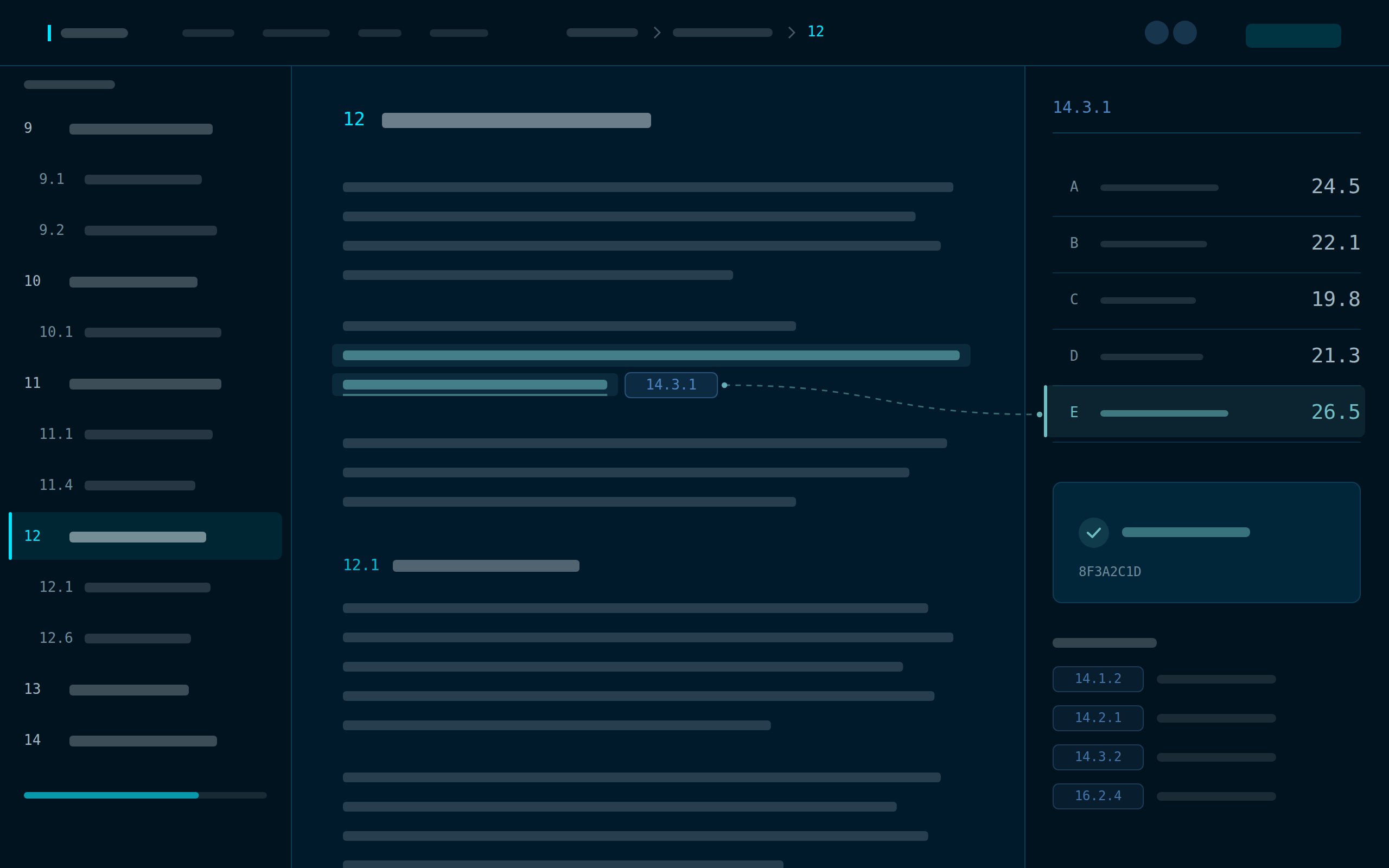
The section tree fills in following the ICH E3 order, each node marked applicable or not for this study, with the table numbers it will need. Sections that do not apply stay visible in the structure, each with the reason recorded.
Pick a drafting mode before the model writes anything, from describing an existing table up to full analytical narrative. The mode sets how far the AI is allowed to go, and it is recorded on the section, so you can always check later which setting produced the text.
Pick a table from the TLF library and it lands in the report with its number, title and footnotes, laid out exactly as programming produced it. Nothing is redrawn, so nothing gets mis-transcribed.
Quality control checks every figure in the narrative against the table it cites, flags disagreements, and offers a correction you can accept. What to do about each one stays your call.
Capabilities
Tooling built for this one document
Each capability maps to a concrete step in writing a CSR. None of it is a general assistant with a medical prompt on top.
Study comprehension
Upload the protocol and SAP; the system extracts design, endpoints, analysis sets and treatment arms into an editable study profile that every later writing step draws on.
TLF comprehension
Parses tables, listings and figures — number, title, footnotes — into a searchable library, and preserves the original layout when they are inserted into the report.
Outline planning
Generates a section outline from ICH E3 and the study's own characteristics, marking which sections apply and which tables each one needs, with cross-chapter reordering.
Controlled drafting
Four drafting modes, from describing an existing table to full analytical narrative. You decide how far the AI goes, and output stays in the document's language.
Source grounding
Before drafting, the system establishes what a section needs, retrieves the matching passages from the protocol and SAP, and only feeds them to the model once you approve them.
Collaborative review
Inline comments, tracked suggestions, @mentions and department review lanes. Comments anchor to character spans, so they stay put when the text around them changes.
Quality control
Automatically checks narrative figures against the tables, terminology consistency across sections, and missing required sections — surfaced as suggestions you can accept.
Export
Exports to Word and PDF with heading levels, table styling, figures and footer notes intact. What you download is ready for your review process.
Workflow
Four stages from source material to first draft
Each stage produces one concrete output, and nothing advances until you confirm it.
The system parses your uploads and extracts study design, endpoint definitions, analysis sets, treatment arms and the TLF inventory into a study profile. The profile is editable: you correct whatever the model misread, and every later step uses your version.
Select a stage for detailStudy profile + TLF library
An outline is generated from the ICH E3 structure and this study's design, marking each section as applicable or not, which writing skill owns it, and which tables it must cite. The outline can be restructured wholesale, and the bindings follow.
Select a stage for detailA confirmed writing plan
Drafting runs against the confirmed plan. Work section by section with immediate adjustment, or submit the whole plan as a batch. Every generation records which prompt version, which inputs and which model produced it, and can be replayed.
Select a stage for detailA first draft with provenance attached
Quality control flags numbers that disagree with the tables, terminology that drifts between sections, and required sections that are missing. The team comments and proposes revisions on one document, split into department review lanes. Export to Word or PDF when it is final.
Select a stage for detailA deliverable Word or PDF file
Provenance
Every sentence knows where it came from
This is the real difference between this system and a general writing assistant. Click any sentence in the sample below and see what it rests on.
Click a sentence to see its source
No sentence selected
The sample is in Chinese: report content always stays in the document's language, independent of the interface language.
A citation is a credential, not a format
Each citation records the source document, the exact location and a content hash. If the underlying table changes, the citation is invalidated and flagged for review. It never quietly points at stale data.
What the model saw is on the record
Every generation stores the prompt version, the list of inputs and the model identifier. When somebody asks six months later how a paragraph came to exist, you look it up instead of trying to remember.
The human keeps the signature
Nothing the system produces lands in the final document on its own. AI output arrives as a suggestion, to be accepted, edited or rejected by a qualified medical writer.
Security
Built to the standard clinical data demands
These are architectural facts about what is implemented. For compliance certification, talk to us during evaluation and we will provide material you can verify.
Multi-factor authentication
TOTP, passkeys (WebAuthn) and email one-time codes, enforceable as an organisation-wide policy.
Enterprise SSO
Connects to your existing identity provider, with central management of members, departments and permissions.
Encryption at rest with managed keys
Documents and uploads are stored encrypted, with keys held independently in a key management service.
Append-only audit trail
Document changes, review actions and AI generation records are all replayable for internal quality audit.
Tenant isolation
Data is isolated per organisation. Cross-tenant access is refused at the data layer, not just hidden in the interface.
Data residency
Hong Kong by default. Other jurisdictions or a private deployment can be arranged on request.
Modules
The CSR module is just the start
The same study profile, the same provenance machinery and the same collaboration platform, extended across the rest of the clinical document set.
- Available
Clinical Study Report
Full ICH E3 authoring, TLF integration, provenance, collaborative review and export.
- In development
Plain language summary
Derived from the finished CSR for participants and the public, with terminology mapped and provenance retained.
- Planned
Protocol & SAP authoring
Moves authoring upstream to study start-up, sharing one study profile with the CSR that follows.
Questions
The questions we hear first
If your question is not here, email us and ask. We would rather settle it during evaluation than have it surface later.
Email usWill our documents be used to train models?
No. There is no training pipeline in ClinAI Studio; it calls inference endpoints and never fine-tunes on your content. How the upstream model provider handles API traffic is set by the contract with that provider, and during evaluation we hand you the terms that apply to your deployment, in writing.
Which model does it use?
Different models for different tasks: reading a protocol, drafting narrative and running quality checks don't ask the same thing of a model. Which providers are in scope for your deployment is fixed in the contract, and it doesn't change without you knowing.
Will we need to validate the system?
That depends on your SOPs and how you intend to use the output; the call belongs to your quality unit. What the product does is make validation tractable: every generation records its prompt version, inputs and model identifier and can be replayed, and every document change leaves an append-only trail. During evaluation we sit down with your QA and work out what evidence they need.
What can we feed it?
Protocol and SAP as Word or PDF; tables, listings and figures as RTF or Word. In other words, the formats statistical programming already produces. Heading levels are read from the document's own styles, so sponsor templates with renamed styles parse correctly.
What happens when it gets something wrong?
It will. The product assumes as much: AI output arrives as a suggestion that a person has to accept, quality control reconciles every number in the narrative against the tables, and each sentence carries its source so a reviewer can check the basis instead of judging by feel. A qualified medical writer signs the report. The model doesn't.
Who owns what comes out?
Yours: the study data, the uploads and the report that comes out. We claim no rights over any of it, and nothing is shared between organisations. Data is isolated per tenant, and cross-tenant access is refused at the data layer.
Can it run in our own environment?
Yes, case by case. The default deployment is in Hong Kong; we can arrange another jurisdiction, or run it inside your own infrastructure.
How is it licensed?
Per report, not per month. One licence covers one CSR: your organization buys a number of them and writing a report uses one. There is no seat count and no expiry — what you have bought stays bought, however many people use it. An interim, a final and an addendum are separate deliverables and count separately. Email us for a quote; we price against the scale of your study and the kind of report you need.
How do we start?
Book a demo on one of your own studies. Bring a de-identified protocol, its SAP and a set of tables, and we run them through the real pipeline while you watch. Your own study is more convincing than any sample we could prepare.
See it on one of your own studies
The demo is not a slide deck. We take a de-identified protocol and a set of your tables and run them through the real pipeline. Email us; we will set a time and tell you what to prepare.
Please do not send any data that has not been de-identified in a first contact.
Already using ClinAI Studio?Open the workspace